

REVIEWDUMP: SHARTINI EDITION
Sadie Coles HQ, Stephen Friedman, Mimosa House, Amanda Wilkinson, Herald St, tastefully-lit hotel bars

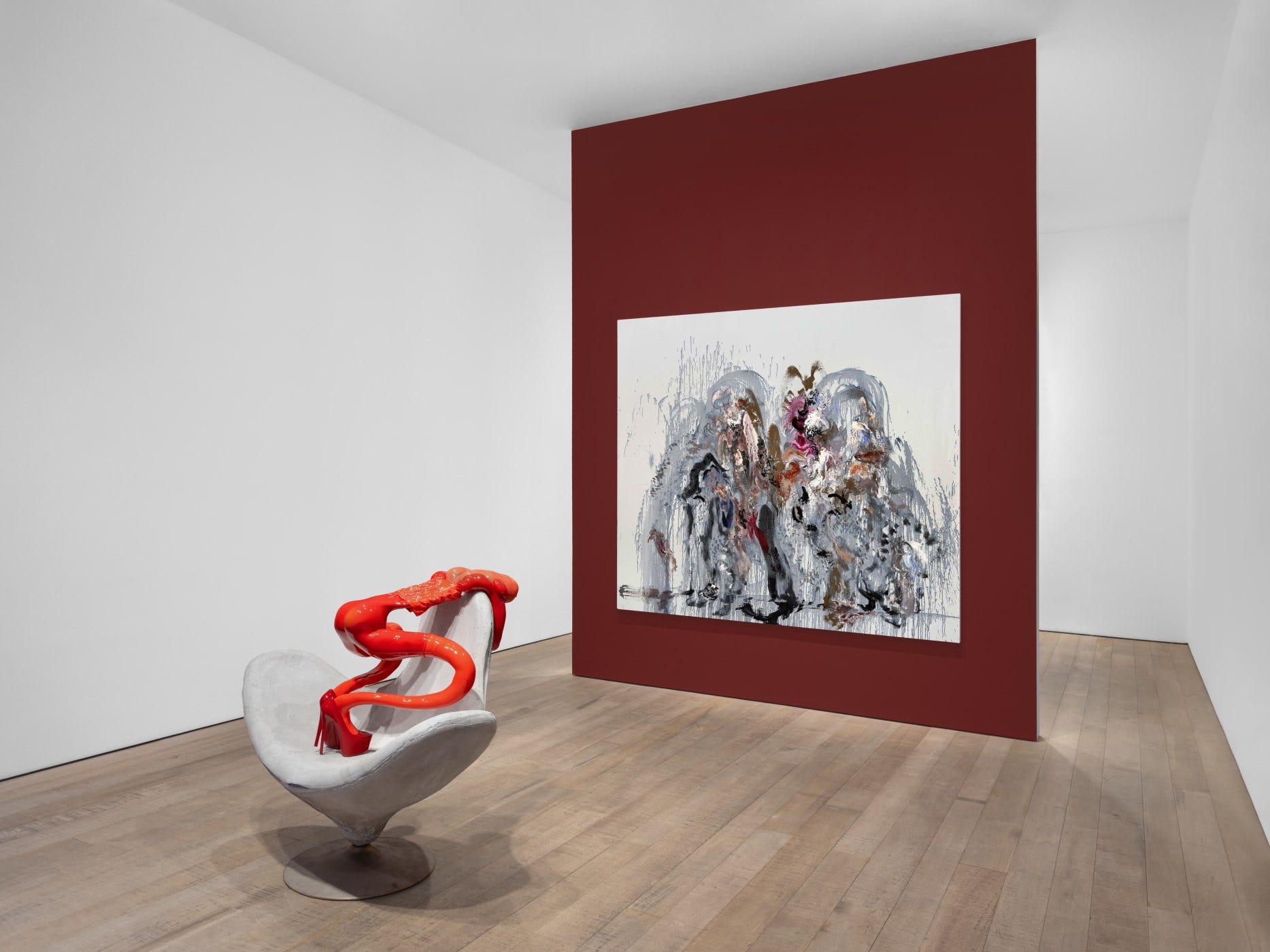
OOO LA LA - MAGGI HAMBLING & SARAH LUCAS @ SADIE COLES HQ ★☆☆☆☆
(A lot of people I like loved this show, apologies if you are one of them.)
I mean it very sincerely when I say I find Allen Jones’s sculptures more servicable to women than Hambling’s or Lucas’s. We fall too often into the trap of believing that sexist things done or made by women are not sexist, or indeed capable of being bad.
There is somewhere floating around the internet an article I wrote in 2020 about Hambling’s Mary on the Green sculpture, which depicted Mary Wollstonecraft naked. My gripes at the time were more social than aesthetic, but as the years have gone on my whining has shifted to encapsulate the visuals of her work too. The less said about her Oscar Wilde sculpture the better1, and the less said about her paintings the best. I tried writing about her particular brand of painterly YBA-era smugness for [redacted] last year and was told I sounded too much like Brian Sewell. What a horrible feeling that was, do you know how catastrophically mediocre your art has to be to make a 26-year-old sound as bitter as the patron saint of patrician disgust? (yes yes, I know that Sewell liked Hambling and some of her work2, even a working clock is broken twice a day)

Lucas is no better. She is not Méret Oppenheim, she will never be Méret Oppenheim, or indeed Eva Hesse, or Bruce Nauman, or Barbara Creed, or interesting. What on earth am I meant to do with these viciously ugly things, I ask myself, these beastly, deflated parodies of women’s bodies, how the hell am I meant to extrapolate meaning or beauty from objects that seem hell-bent on embracing the circumstances they claim to criticise, these derivative masses of nothing? ooooohhh women are (treated) like objects? Even her fans can’t speak of her highly; Kathy Battista dedicates a whole chapter to Lucas’s photography in her 2009 book Ladies and Gents and can’t find anything more interesting to say than she “uses the toilet as a substitute for and an extension of the female form.” This is bargain-bin Freudianism, this is a joke, is this a joke? Am I the joke?
“On the one hand, it’s about looking at the old things,” says Lucas, “and on the other, it’s wanting to bring them right back to a state of freshness that has to have something to do with right now.” Oh, fabulous, so it’s about nothing at all then, excellent, fine. “The one crucial thing that only painting can do is to make you feel as if you’re there while it’s being created.” says Hambling, which is an insane statement, what on God’s great earth are you talking about, what do you mean painting has a monopoly on immediacy, on gesture, on presence? My God, sculpture exists, prints exist, performance exists, everything carries something, you’re not Moses bringing down the tablets, do you look at the Löwenmensch and not feel the mammoth? I’m going to have a fucking heart attack. You’re a smoker for Christ’s sake, we’re on the same side; we’re mean to be better than this. Who the fuck cares that you met at the Colony Room and share the same birthday? What is the connection between these two women and their works? It’s so over for art that it never even began.
My greatest irritation lies perhaps with Sadie Coles. All this money, all this space, and you can’t move away from the Law days. Jesus. At least let the 90s die with a little dignity.
EXHIBITION OF OLD ROPE - DAVID SHRIGLEY @ STEPHEN FRIEDMAN ★★★☆☆
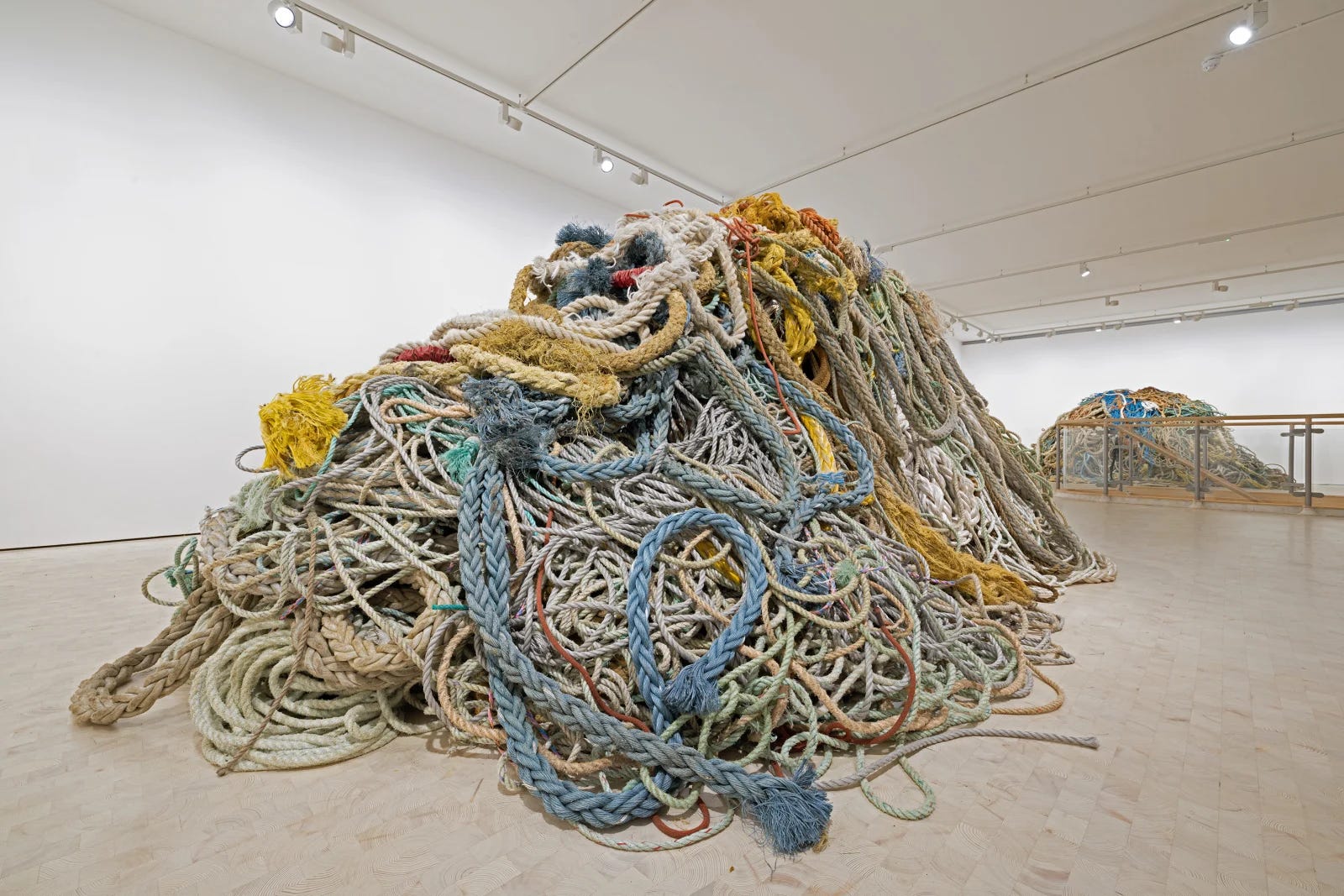
I think I’m meant to hate this show: it’s clearly designed to be the sort of rage-bait that I am usually not above falling for (see above), but unfortunatetly it looks really good, and sometimes we must submit ourselves to the base pleasure of visuality.
Ostensibly, the concept behind the show is some kind of delapidated meta-commentary on the politics of value, of the art market, of appraisal and assesment, which I sort of thought Duchamp has closed the box on, but whatever. This is easily sidestepped by not caring about what art costs. The quality of an artwork is not necessarily unrelated to its value (I’ve been enjoying the back and forths between Jeff Magid and Kenny Schater on Instagram, who have both made some salient points about whether or not we should care about last week’s record-breaking Klimt sale - art is (not?) made in the salesroom, etc), but it’s clear that the valuation of a piece can be (and usually is) totally divorced from its aesthetic and ethical calibre.
There is something freeing in the syllogistic logic of I’m not going to buy this art, therefore its price is irrelevant, therefore the discourse it wants me to participate in does not affect my interpretation. If price is merely an accidental property, then by definition it cannot belong to the essence of the artwork, which is precisely the non-essentialist point: nothing contingent to an object - market value, hype, discourse, press/press releases - can determine what the thing is, even if you’re making fun of that fact. As with Lucas’s approach to gender, satire requires a clarity of purpose and I’m of the firm-ish opinion that making fun of the ecosystem you profit from renders the commentary null by merit of participation.3

So, if the ethos behind the show is tautological at best and redundant at worst (or perhaps vice versa?), it leaves us with pure aesthetics from which to judge it, which I found to be really pleasant and impressive. I’m a huge sucker for braiding, sorry. There’s a bit of post-minimalism here, the classic Richard Serra/Robert Morris ‘dump stuff on the floor and good luck to all future curators/art handlers’, a formal impermanence that I find really yummy. We will never see this rope in the same formation again, which can be said of all trash heaps but makes them none the less beautiful. The show smells, too, which is really cool, different olfactory layerings of plastics and hemp and dried salt.
I also like the idea of discarded rope in general. When does rope, or indeed any tool, stop being worthy of use? How do you decide when an item is too damaged for what it was born to do, what hylomorphic quality of the object makes it “good” enough - for sale, for operation, for life? This is in and of itself a commentary on the tension between Scholastic and Empiricist ideas about value and its relation to reality; Artistole has one answer, Locke and Hume another, Shrigley a third. That being said, I still don’t like any of David’s other works4, so I’m going to be mean and chalk this up to an accidental stroke of cleverness.
SHOW LESS - CLAIRE FONTAINE @ MIMOSA HOUSE ★☆☆☆☆
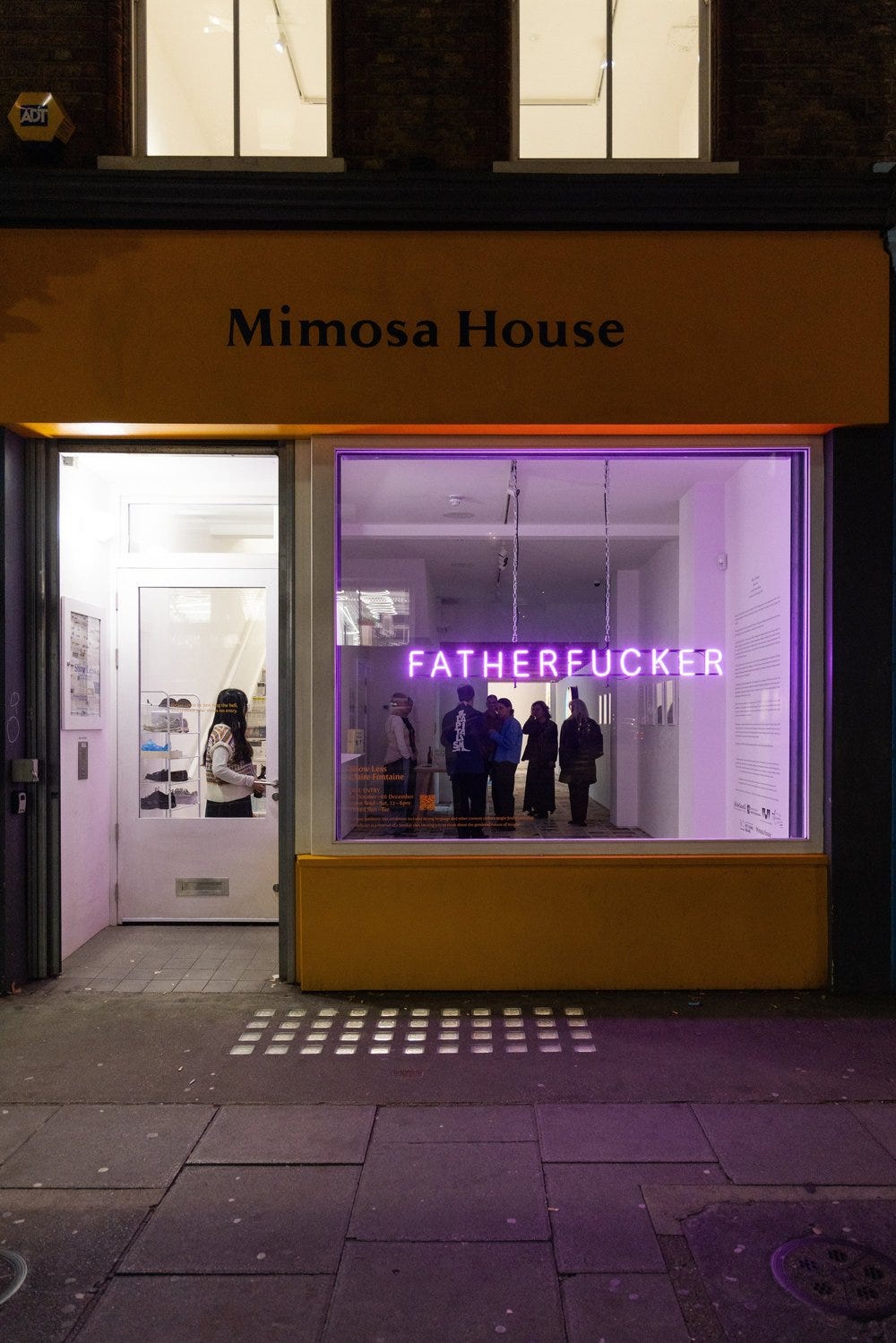
I originally wrote quite a lot about Show Less for this Reviewdump, relating it back to Foreigners Everywhere and Pedrosa's curation of last years Venice Bienale, but around the 1,800 word mark I realised I had already put more effort into thinking about this show than anybody else involved. Perhaps the title should be taken as advice.
THE ANGELS ARE DIALS - JULIA DUBSKY @ AMANDA WILKINSON ★★★★☆
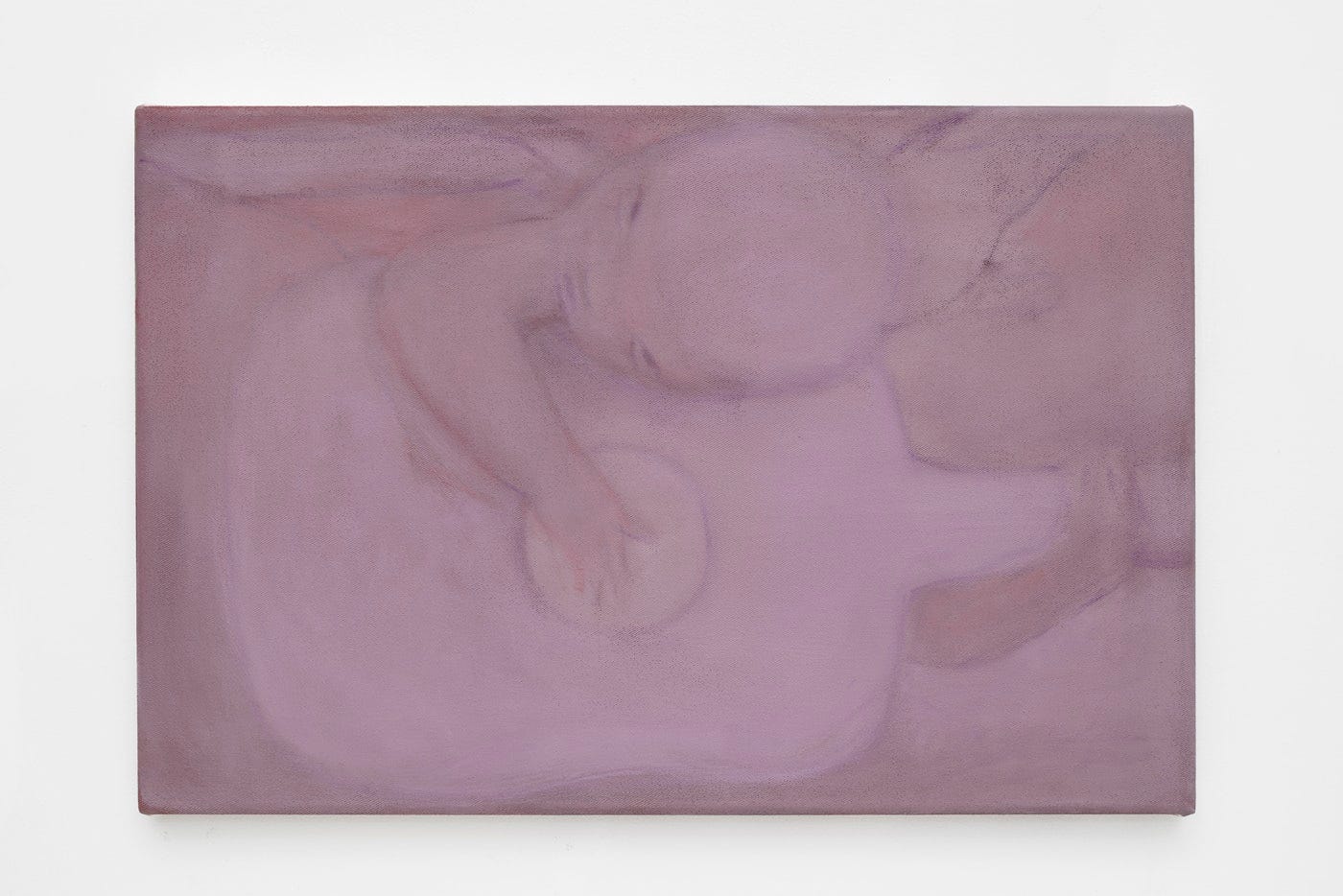
It is so incredibly tricky to make paintings that know that they’re paintings, especially if they are referencing other, older paintings. This is all Malevich’s fault, whatever, but Dubsky gets it. Fuck, these are beautiful. Dubsky’s actor/painting analogy rests on the idea that an artwork appears doubly, both as itself and as the thing it depicts. Her works, especially her dypitchs, embrace the same truth as Calasso’s Tiepolo Pink, that appearance is the real.
Stars of the show are the recreations of Rosso Fiorentino’s 16th century Cherub Playing a Lute. Il Rosso (“the Redhead”) was already leaning toward what would become Mannerism: elongated limbs, acidic colour, ambiguous space, emotional languor. Reflectographic studies tell us that the Cherub is a fragment of a lost altarpiece; a fact that Dubsky absolutely revels in by treating the missing whole as a kind of luminous, atmospheric pressure. You get absolutely sucked in by the sense that something larger is breathing just off-canvas, that the cherubs are indeed behaving like actors responding to a scene partner. Maybe you’re the other performer, idk, I’m going to be terribly boring and say you really should go and see this show and work it out for yourself. Like, IRL. Yes, I know it’s cold outside, but this is worth it. It’s on until the 6th of December.
BRINK - AARON ANGELL, HENRY GIBBS, SIMONE GRIFFIN, MIRANDA KEYES, ELISE NGUYEN QUOC, CLAIRE OSWALT @ HERALD ST ★★★☆☆
Tell that its sculptor well those passions read
Which yet survive, stamped on these lifeless things.
— Shelley, Ozymandias, 1818
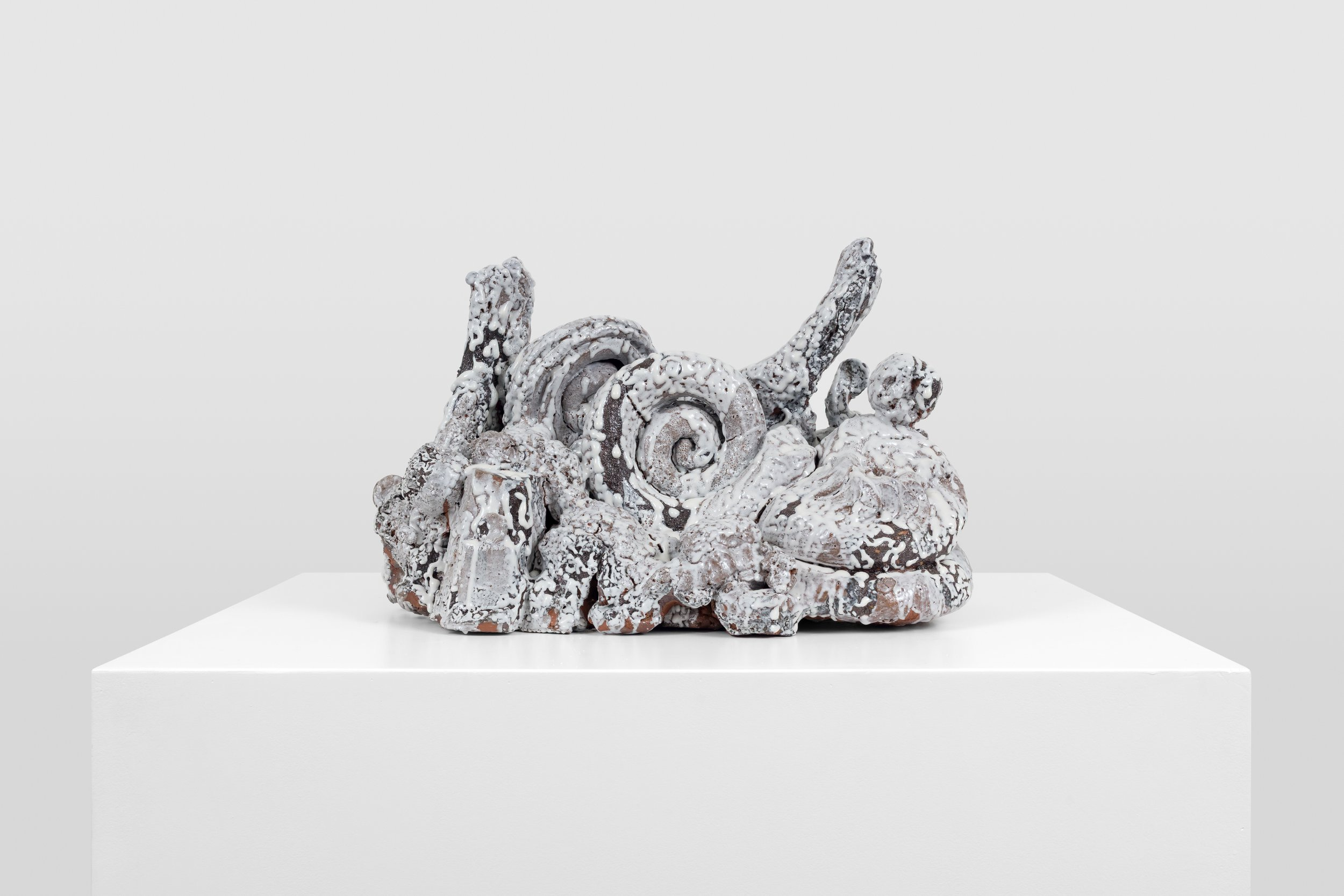
This is turning out to be quite a sculpture-heavy week, which Herald St is good at. The last time I visited the gallery they were showing Nicole Wermers, whose fur hoses I didn’t love (I want to see more real animal products in art!!) but whose clay figures I found really delicious. Herald’s sculptors know how to speak to art history; just as Wermers’ works spoke to the Baroque/Sevres tradition, Aaron Angell’s artefacts make use of Anglo-Japanese ceramic techniques to create a kind of unearthed, semi-archeological relic and Miranda Keyes’s glassworks arrest the liquid event. I am sorry to harp on about the Ozymandias Effect, I feel like Gretchen Weiners trying to make Fetch happen (lol) every time I do, but I do find it significant that so many artists are actively (and, in this case, very beautifully!) engaging with the pre-emptive ‘demise’ of their own works.
You can see this in Henry Gibbs’ Futurist-inspired markmaking, Elise Nguyen Quoc’s grainy, urban pigments, in Simone Griffin’s microbial feilds: contemporary objects self-consciously wearing their own future ruin/overgrowth/collapse. Clean, concise, if a little pseudoclinical; the inclusion of Claire Oswalt felt a little mean, not because her work is bad (it’s not) but because if you’re going to commit to the white-and-grey, apocalypse-via-paleology thing then you need to go the full mile and not include any colour at all.
DRINKING A GIN MARTINI IN A FUCK-OFF FLUFFY COAT @ THE DIXON HOTEL BAR ★★★★★
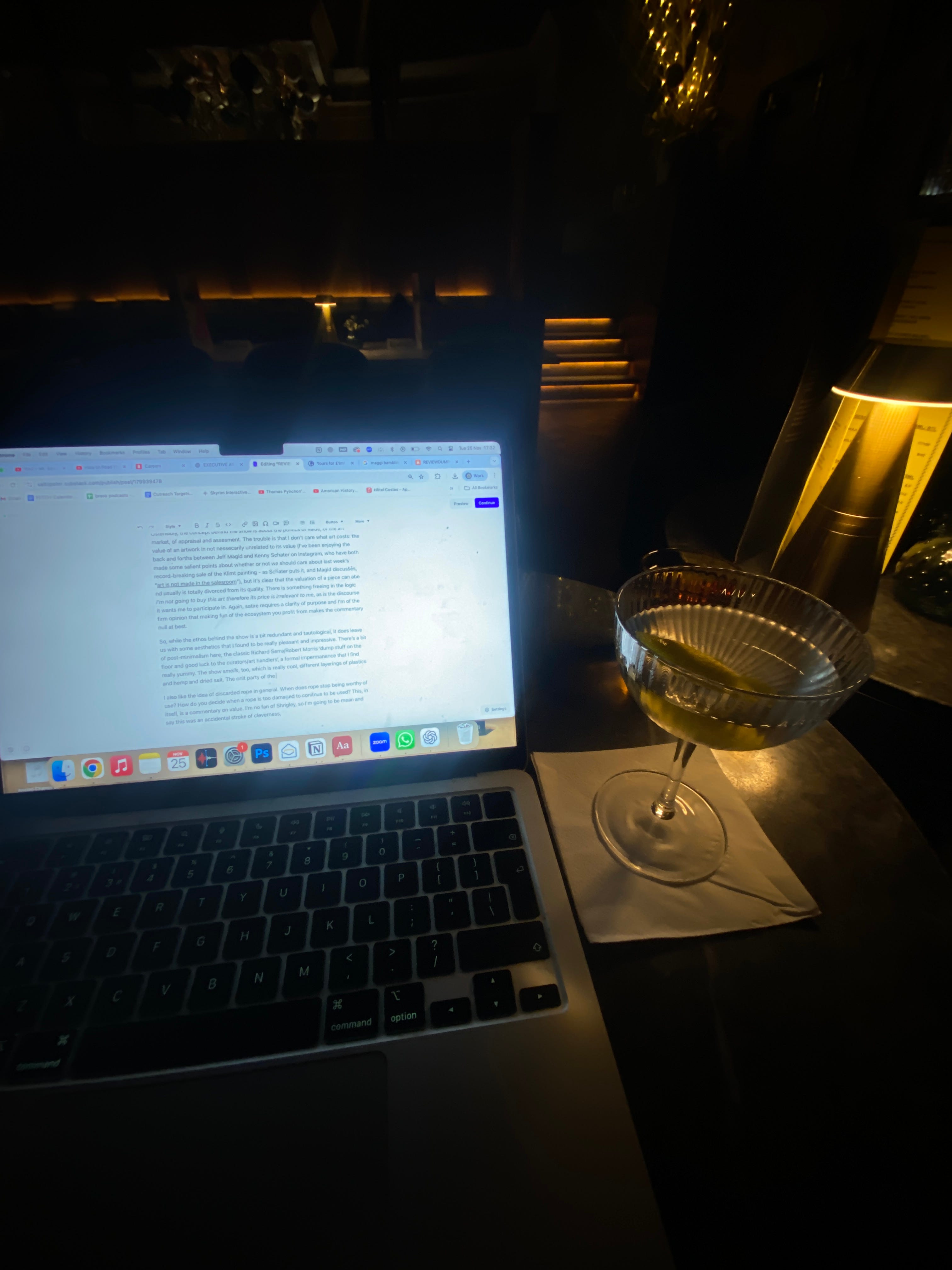
When I was in my early twenties I invented a drink called The Shartini; two parts gin, one part expired caper juice. The name is self-explanatory; you’ll be shocked to know I only made it once. Since then I’ve been very scared of the drink, but I’m slowly coming back around to them.
The gin martini is a fundamentally Girardian cocktail (as opposed to the expresso martini, fundamentally Freudian). You don’t order a martini because you enjoy it; you order it because you want to signal something half-carnal and half-correct about yourself. In my case that something is a very nice coat in a very nice hotel bar. Bonsoir.
FINAL THOTS
Went drinking at the French House recently with a woman who very wisely pointed out that you shouldn’t fall for any of the bartenders there, for the simple reason that there is a small platform behind the bar that makes them appear deceptively taller than they really are.
You should buy a copy of Die Quieter Please now right now now now. It’s a very cool lit mag ran by very cool people, with some exceptionally good writing inside.
Some people have expressed confusion over my rating system. To be clear, I never give shows five stars (unless the gallerist has personally given me twenty-five thousand euros, or maybe an orgasm). Zero and five stars are generally reserved for things like food, sex, people.
Would love an American, or perhaps a very slimy Italian, to explain to me what is going on with Alma Allen + his galleries.
spittle call me a pre-alcoholic in their GOD SAVE THE SCENE substack, which you can and should read here.5
TEXT OF THE WEEK
An opinion admittedly unhelped by the fact that the last time I was on Adelaide Street I had just taken a hit off a friends vape which I later discovered to have been laced with salvia.
Being a hypocrite has never stopped me from being right.
If you’ve ever been to mine and seen his salt and pepper shakers in my dining room, shut up, no you haven’t. Ghost in the machine. Mandela effect. Performance art.
I know nothing about art criticism but I eat it up every time because it's fascinating and enthralling. Do continue
These reviews give me a kind of fun, disorienting feeling, like what I imagine someone who’s never seen a film would experience reading Sight & Sound (I know nothing about contemporary art). Do you give so many 1 stars because the London art world is a bit rubbish? Or are you very exacting?