

REVIEWDUMP: BACK 2 SCHOOL EDITION
Niru Ratnam, Gillian Jason, Maximillian Williams, Charlie Kirk's shooting

My psychoanalyst has suggested, for reasons purely between Freud and myself, that I tend to give nicer reviews only when I’m celibate. This week’s reviewdump proves him incorrect; although September is the entrée scolaire for the art world so they tend to put their brightest and bestest forward. Good art, in general. A shame Thursday was tainted by the incoming civil war across the pond, but who knows, perhaps Banksy will make another mural and solve the whole thing.
NIRU RATNAM — Adham Faramawy, The Earth Laughs in Flowers
★★★★☆

“Where Order in Variety we see,
And where, tho’ all things differ, all agree.”Alexander Pope, Windsor-Forest: To the Right Honourable George Lord Lansdown, 1773
“It is the folly of too many, to mistake the echo of a London coffee-house for the voice of the kingdom.”
Jonathan Swift, The Conduct of the Allies, 1771
Faramawy’s rivers are Windsor Forest after empire, after smog. Like Pope’s (whose 1773 poem Windsor-Forest: To the Right Honourable George Lord Lansdown, his work takes inspiration from), The Earth Laughs in Flowers’ pastoral vision naturalises political economy and politicises the economy of nature; unlike Pope, whose Thames flows “for all mankind” in perfect balance, Faramawy stages the river as a site of contamination and contest. There is no poetic ratification of peace (or the London coffee-house goers’ version of it), no panegyrical georgic of the Treaty of Utrecht or the Tideway Tunnel.
The use of parakeets as postcolonial stand-in is especially good. London’s wild ring-necked parakeets are often read as an invasive species, despite being synanthropic, hoisted their own mythological petard (originally from East Asia and Africa, escaped from Hendrix’s Carnaby Street flat, from The African Queen film set, etc). In Hindu iconography, the parakeet is the bird of Kamadeva, sometimes Rati, symbols of erotic speech and fertility, which links nicely to both Pope’s feminised Windsor Forest nymphs and Faramwy’s queer-erotic counter-pastoral.
I do fear, however, that video art is dying. You can be as clever and sincere as you like, which Faramawy’s work is, but the problem is not sincerity; it is faith, not just in the form but in an audience virtuous enough to sit down and pay attention to something for 18 minutes. If we had been capable of this after Blenheim, there would be no dead doves in the Thames.
GILLIAN JASON GALLERY — Emily Ponsonby, A Warm Life Through Butter
★★★☆☆
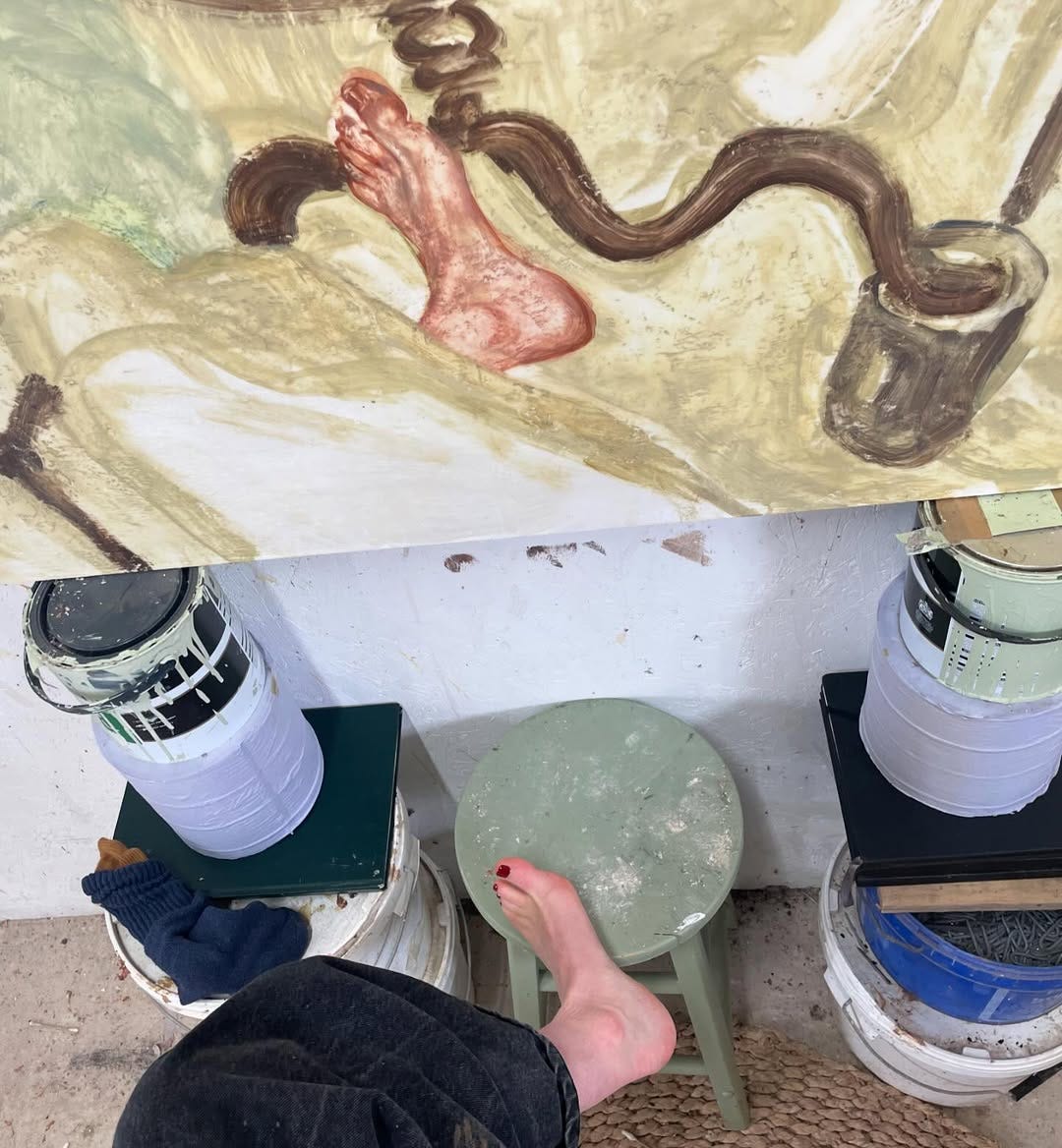
Automatic star awarded for the last name Ponsonby, what a fantastic use of vowels.
Anyway, A Warm Life Through Butter is marginally better than her March show with GJ. These latest works by Ponsonby (God, I’m going to call my son this, that or Victor, short for Victoria the Lesser) are tender, textured, domestic yet lively. I like them a lot, seriously, these are well-crafted and atmospheric works with a lot of feeling behind them; straight up and down, confidant, beautiful art.
I’m just very iffy about works that has to signpost the viewers’ participation. Ponsoby does this with a sort of (Lucian) Freudian fish-eye, a top-down POV/perspective that posits the audience as a contributor to the scenes she depicts: someone sketching at a family-style dinner table, someone shucking peas for an al fresco meal in the sun, someone reading a love-letter at a edge of an outdoor bistro, toes and fingers and hands stuck at the front-bottom plane of the works that suggest that I too, am tucking into a rustic spread somewhere warm and beautiful. This is the fish-eye as mirror stage; the hand that holds the wineglass could just as well be mine, an uncanny body stretched and foreshortened, severed, grafted into somebody else’s dinner.
The trouble is is that I’m not an artist at my found family’s table, nor am I a writer in a bohemian cafe. I’m a hungover 26-year-old chainsmoker in a gallery on Great Titchfield Street with a wet hole in her boot and enough money to buy either cigarettes or dinner for the next week but not both, and certainly not enough to buy any of the paintings I’m looking at. Perhaps this is the point, perhaps the melancholia of méconnaissance is a feature and not a bug of the work, as it is in Alexandra Zarins’ paintings, which employ a similar fish-eye perspective to dramatise the mirror stage as misrecognition, but depict (what I find to be far more fitting) scenes of chaos rather than domesticity. Perhaps it’s just the oldest trick in the book, that slight coercion of “relatability” which lets bourgeois collectors see themselves at the table. Either way, A Warm Life Through Butter still made coming home from the PV to my single blue-lit boiled egg and half-bottle of Sancerre feel rather cold in comparison.
Someone, not me, should write about why these sorts of POV angles are making such a resurgence; one suspects it may largely be to do with TikTok, Evelyn Waugh, the numbers 5, 25, 5, possibly even 19.
MAXIMILLIAN WILLIAM — Group exhibition, A light here required a shadow there
★★★☆☆
“He must buy a new carpet for the staircase. Perhaps she would go with him to buy a new carpet for the staircase. ”
Virginia Woolf, To the Lighthouse, 1927
Interestingly, more scenes of domesticity here. Surely it says nothing worrying about current society that we are turning to painting to express the kitchen table, the family dinner, the owned home. Lacan argues that “love creates its object from what is lacking in reality” and I suggest the same can be said about representational art.
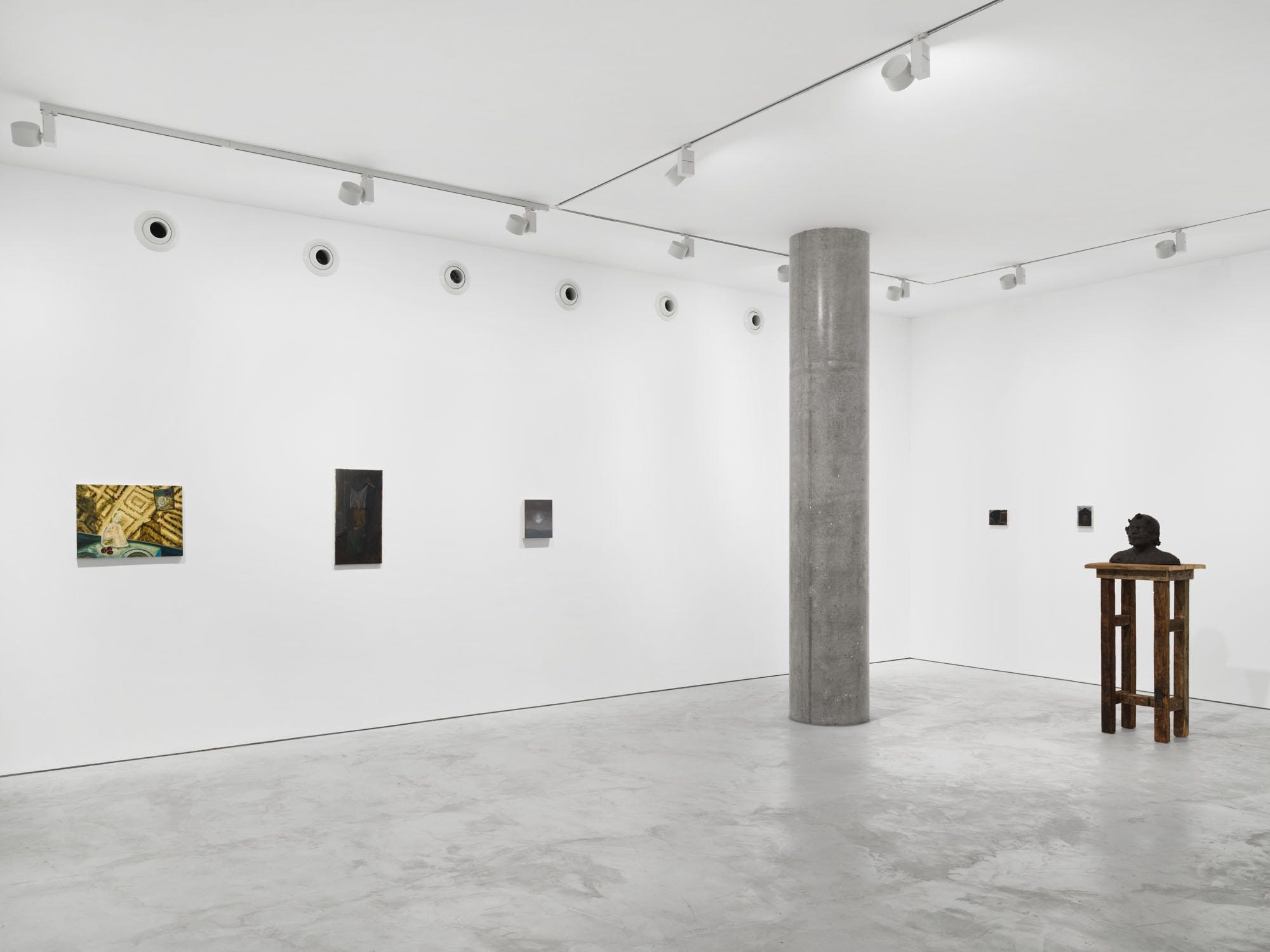
The curation of this show is divine and does the best it can with what it has; what unites the show despite its stylistic spread is how each painter stages what is missing rather than what is present. Rimantė Mikulovičiūtė’s dining rooms revive the table as a civic form, Arendt’s space of the polis, Lefebvre’s production of space; Dylan Williams miniaturises the Romantic sublime, Turner’s skies only appearing because they no longer exists in real life/outside of paintings/literature/memory; Benjamin Sasserson explicitly evokes acheiropoieta (images not made by human hands; specifically St Veronica’s veil, itself an image of an image)1, Bu Shi piles Buddhist-European vanitas iconography into an afterlife of objects that only accrue power once their living referents are extinct (skulls, coral, crystals); Grant Falardeau… well, Grant Falardeau is also there.
To return to Lacan, what is repeated in these works is precisely what is missing; love, reverence, even beauty create their object out of lack. The title of the show is taken from Virgina Woolf’s To the Lighthouse, when she has Lily Briscoe explain her painting to William Bankes: “a light here required a shadow there.” It’s part of a larger passage where Bankes admires a triangular shape, notices how Lily balances light and darkness in her canvas, not to reproduce a likeness of Mrs. Ramsay and her son, but to evoke something more general; a mood, a tension, a missing centre of coherence. What Lily wants to convey is not presence (the mother, the child, “a subject which, they agreed, Raphael had treated divinely” as Lily puts it) in their full form, but the crossplay between what is shown and what is withheld, what absence makes illumination legible, why Mary is more beautiful sans Jesus. If love creates its object from what is lacking in reality, then Lily’s dictum is its painterly corollary: light is only ever legible against shadow, intimacy against distance, presence against absence. The exhibition takes this seriously, or tries to, but it’s one of those ‘don’t think of a pink elephant’ kind of situations; the more insistently absence is staged, the more noticable its contrivance becomes.
However, five stars for Colton Karpman’s The Shelf staging.
In fact, five stars for the concept of The Shelf in general. I love this gallery.
MY 1980S DISHWASHER, LA MORT DE MONSIEUR KIRK
★☆☆☆☆
Refilling (as one must) my dishwasher this morning I came to the conclusion that it was wiser not to lay my big Le Creuset against my little gay mugs lest it deprive them of cleansing, before remembering that water has no morality; it will, as per Pascal’s Law, fill the space given. This is in some way related to Charlie Kirk.2 He will be afforded the version of heaven he believed in, as will my darling porcelain soup bowls in my 1985 Bosch S610, sluicing away the six-day old sushi from the chopsticks I put in my hair when I’ve given away all my bobbles to handsome blondes. As the only man on Substack Philip Traylen has noted, “Rejoicing over someone’s death is vulgar exploitation, pointing out that rejoicing over someone’s death is vulgar exploitation is also vulgar exploitation, this is because immediacy itself is vulgar exploitation.” The only solution, I believe, is to simply never die at all, which none of us ever will. As Heraclitus says, “upon those stepping into the same rivers, ever different waters flow.” There are Kirk’s children, and there are those make memes about the phlegethon poured from an idiot’s throat.
FINAL THOTS
I am enjoying how increasingly obvious art market reports are becoming. Established price points are causing a “rebound in confidence”, you say? Larger galleries that fast-tracked artists into premature stardom are now “facing the consequences”, you say? Eating the mold growing in the corner of my shower is “bad for my health”, you say?
Accidentally took an Italian panettiere to Pizza Express this week, who produced a peice of criticism that I feel may be relevant: "the amount in which we debase ourselves to consume [Pizza Express food, contemporary art] is not so abhorrent that we cannot enjoy ourselves." Brecht speaks of this, probably.
Very, very badly would like get a tattoo above my pussy that says 𒅥, but alas, I fear whatever Sumerian diety I would summon would not approve of my lifestyle choices.
Or a meta-icon; in the Renaissance and Baroque, the veil itself was often covered minus certain feast days.
Men (in the Platonic sense) should be able to talk about whatever they like, and certainly shouldn’t be shot for it. Women, Jews, creatures (in the Aristotelean sense) should be able to curve a finger over the wall’s shadows and say sure, come back to bed, don’t forget the shiva wine I paid for. This is not our fault, God help us.