

On [redacted] Gallery
A last-minute rant about British class and the hypocrisy of the London art gallery circuit


“Please, let me write one hit piece before January.” I plead with my publicist when she asks what I want for Christmas. “I’ll make it intellectual, I’ll make it funny, whatever. Just let me rip into [redacted] gallery as hard and as nastily as possible.”
The placatory arrival of the ever-eirenic Fortnum & Masons hamper this morning tells me the answer is no, so I’m afraid my final substack of 2024 won’t be nearly as vicious, interesting or long as I want it to be. But it will touch on perhaps the most observable sin of the London/Western gallery circuit, which is hypocrisy — and who knows, perhaps some keen-eyed Londoners will be able to figure out which institution the subject of my ire truly is.
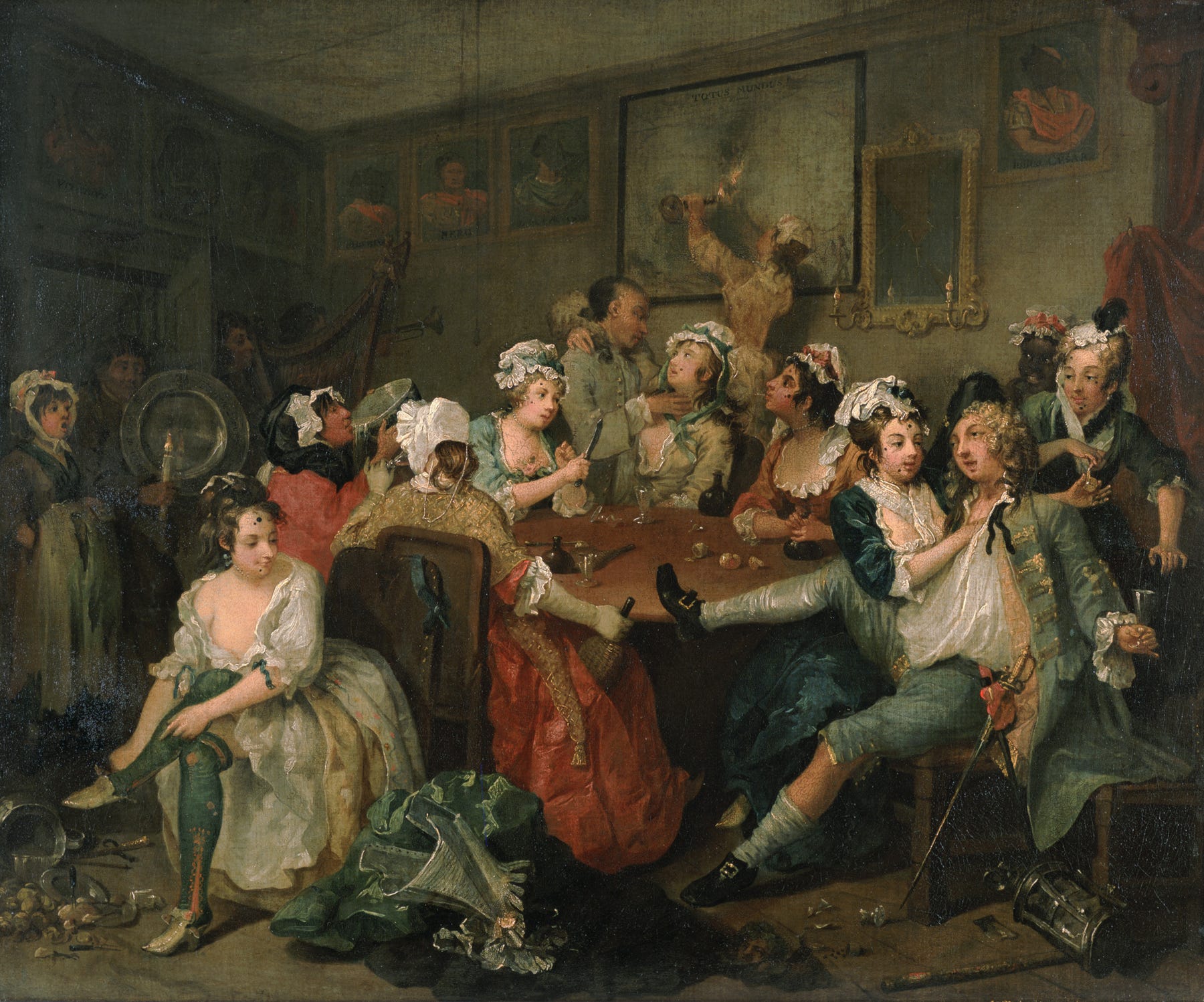
This year has seen a significant push towards righting a wrong in metropolitan gallery culture that has been a staple of the scene since the sixteenth century, which is the overabundance of rich people. I’m tempted to call this movement admirable because while it runs parallel to the shift in both collector and curatorial attention towards giving black/brown/gay/trans/women/etc artists their flowers, there has been an overall failure in both American and European institutions to address the actual thing that matters, which is class.
Classism is a general affectation of the art scene in any Western city, but perhaps London the most. Britain is one of the few places on earth (or at least, in Europe) where your class is almost immediately apparent through your speech and this can and does hold a lot of people back. Anybody who pretends otherwise is either uninformed or obtuse; not only has there been a nonconfutable amount of peer-reviewed research on the topic, but I’ve personally overheard genuinely loathsome comments from press officers and gallery managers alike in regards to people with non-RP accents. This is especially true for Northern artists and professionals, but I have seen it extended to cockney/patois/North London speech. Naturally this runs parallel to race and nationality; I have also seen it proffered to anybody perceived as being general non (white) British. Several Indian writers I know in London have complained of discrimination by a particular Cork Street gallery whose press officer would, through a series of bizarre and intrusive questions, try to work their caste, and another just further down the road whose upper-class Irish manager asked a Nigerian friend if she had ever heard of Van Gogh.1
The whole street, in fact, seems to suffer from old-school class jingoism on an unprecedented level. Curator and critic Sophie Nowakowska recently pointed out the horrendous attitude of the receptionist at No.9 Cork Street when she popped in for a visit. I don’t know if this had anything to do with the fact that Nowakowska is Polish, or indeed if it’s the same receptionist, but I remember visiting a show at No.9 in May with a heavily-accented Palestenian friend who took the lead in asking for information for whatever ghastly New York gallery’s show was on at the time. His treatment was much the same until I, avatar of the Eurotrash-RP accent, piped up.
I am likely being extremely harsh on some underpaid interns who let power go their head, but I think it’s a good illustration of a problem that permeates a significant portion of many London galleries who continue let themselves be dictated by antiquated ideals of where art-world money actually comes from (any market-savvy desk teller should have been much more excited by a homosexual Arab in Rick Owens than a chainsmoking Jew in DKNY — indeed, should have recognised Nowakowska as one of the most followed social media critics in the city). I would be willing to admit the anecdotal nature of these incidents if not for the significant amount of pro-working class art collectives that have sprung up since the start of the year, clearly all hoping to rectify an issue clearly deemed irrefutable (Meg Molloy’s Working Arts Club comes to mind, although beyond hosting a few talks I’m still unsure what they’ve actually achieved - more on that later).
All of this to say that despite cries of ‘affirmative action’ in the UK and European art scene it has clearly not trickled down to those who are perceived as belonging to lower socioeconomic brackets, especially those whose class system lies outside of the classic British stratum. Many London based galleries are very, very eager to show themselves to be ‘on the right side of history’, or to show themselves engaging in the honourable act of filling their employee and artists rosters with people from working class backgrounds. Showing, however, is not doing.
Before I get onto the bitchy stuff, a general note about how and why certain galleries approach the challenge of solving social inequality through art. Contemporary art is ostensibly predicated on a foundation of liberal social progressiveness and economic permissibility. This is of course true of its civic and curatorial aspects (as noted by Ben Davies, Westerners who interact and react to contemporary art are already functioning with a framework where “centering the marginalised” has been a pretty central aspect for the better half of a decade), but its economics are also very neoliberal: tax-advantaged freeports, elastic pricing, luxury retail strategies, deregulated global markets, etc. If you wanted to be especially heinous, you could even argue for inequality as a driver of innovation. There’s plenty of wriggle-room regarding where we might place the art market on the broad scale of economics but one thing is for sure: it is not on the supply-side (a fact someone should probably let Jerry Saltz know).
Galleries are at their core economic entities and it serves little to pretend otherwise. This is far from a bad thing: regardless of your position on identity art it is clear that the best way of supporting any artist, minority or not, is through money. Criticising any art worker who looks to galleries as a way of securing their livelihood is like telling a suffragette in 1912 or a gay marriage activist in 2008 that they’re being an assimilationist: you’re technically correct, but you’re also being a pedantically short-sighted armchair revolutionary with no sense of realpolitik. We can bitch and moan about the hows and whys (personally I blame Spivak and Foucault) but the current fact of the matter is it a good thing when artists and art workers get money: selling out is always, always worth it. Elliot Earls has more succinctly delved into the ways various modern art institutions have tried to discourage this narrative, and I volunteer a quote from his video essay Anti Capitalist Posturing and Stupidity In Art: “I do not know one artist who does not want the ability to sustain themselves from their work. This does not mean that late-stage capitalism is not predatory, [only] that it is possible to make art and design ethically.” The gallery system is integral to this ethicality, and I think this is something that all owners subconsciously understand. How effectively or correctly they use this knowledge is an entirely different matter.
The gallery that prompted this rant is a relative newcomer to the London gallery scene, but has over the past few months come to represent the absolute worse of progressive PR masquerading as class solidarity. Whoever does their press has been working overtime because they’ve been featured by Artnet, Ocula, TAN, Elephant and Dazed this year, which is why I’ve been paying attention. One major aspect of their media junket has been pushing the fact that their founder is very much not a nepo baby, thank you very much, and the other is that not supporting poshos, whether they be artists or art workers, was a fundamental value of their operations. So far, so good, right? This is a gallery run by someone who clearly cares about giving opportunities to artists and art workers who are held back by an antiquated British idea of class, right? Surely all of this overt postering will be reflected in their professional and artistic choices… right?
Well, no. According to a few insiders, the owner is actually very much not working class, although this is pretty par for the course for the London circuit (Pulp’s Common People should be an East London anthem at this point). More significantly is the fact that their artists roster consists of nepobabies par excellence, the kind of progeny who don’t even attempt to deviate from their famous relatives, either stylistically or socially. Their latest hire is European aristocracy, one of their sales associates is British aristocracy, another employee told me after a drunken night out that they were “Monaco royalty” and although I now know this fact to be untrue (one of the less nefarious privileges afforded by being an upper-class art worker is being able to sniff fibs like this one out with the savagery of a bloodhound), it says a lot that this was a lie deigned worth telling in the first place. And yet, here they are, gainfully employed and paid by a gallery who consistently sells itself as a haven for the working class, the downtrodden, the under-represented.2
There is a certain element of manifest transparency to galleries and institutions who claim to care about achieving a rectification of “social inequality” that is, in my opinion, very often unattainable. Firstly, I’ve found that galleries actually doing the sort work that has any sort of social impact don’t have to announce it, they just do it: they get members of the community involved in exhibition, they promote artists who wouldn’t usually be introduced to the contemporary circuit, they exhibit art that speaks to and very often is made by members of political and demographic strata that don’t fall neatly into the usual first-year-at-CSM demography. You don’t have to have long rambling press releases about how you’re supporting under-represented artists — you just do it.
Secondly, I don’t believe anybody who is bigoted in ways that matter is going to engage in the sort of art that these galleries show. Ironically, it is a sign of incredible social privilege to believe that a painting in a cushy Islington gallery is going to stop someone with hiring power from being prejudiced. The person who denies me a job for being a filthy kike will not suddenly offer me the position because he goes to see a Nan Goldin exhibit. It is even funnier to imagine someone who already works for, let’s say, the V&A or Christie’s, going to a talk hosted by Sophie Macpherson and Working Arts Club and saying anything other than “it’s probably a good idea not to only hire rich, white men”. Nobody attending or organising these kinds of exhibitions or events seriously thinks that they’re the problem, and in fact may even sincerely believe they are a part of the solution. The idea that “conversations" around class lead to anything else that just that — words, not actions — is an acutetly bourgeois pretention. As noted by Michael Zweig, the field of working-class studies in the arts has been going strong since the deindustrialisation of the 1980s, but decades of middle class attention to class inequality has very clearly achieved a big fat load of nothing.
And so, one has to ask — what on earth do these sorts of institutions and events bring to the table? Because it certainly isn’t money to working-class people. Millionaires spending big bucks at Christie’s auctions certainly couldn’t give less of a shit if you think they’re elitist, yet alone attending events called ‘Class Talk’ (now THAT’S assimilationism). What they do bring is an assuasion of guilt to those already profiting from the same framework they are claiming to dismantle. Of course, the way to actually level a century-old tennet of a global industry is not through talks or panels or Guardian articles or pithy Instagram posts, but by putting your money where your very, very busy mouth is. But this involves turning down the children and siblings of well-established artists for exhibitions or hiring people who haven’t shelled out £30,000 for an MA from Sotheby’s — a step most London galleries simply aren’t ready to take, because rich people are a feature and not a bug of the system.
The blatant use of well-intentioned political movements in order to appear socially conscious while continuing to capitalise from the same old shit is as intellectually as it is morally repulsive, but it is also deeply, deeply unhelpful. The louder a gallery can yap about how good it is to working-class artists and art workers, the less it actually has to do in terms of material action. Don’t fall for it: the only way to know if a gallery really is committed to supporting working-class artists and art workers is to look at who they exhibit, who they hire, and how they pay. Words are cheap; money isn’t.

On a personal note, I will be chairing the Encounters artist panel at the London Art Fair this coming January. If you are based in London and like my writing and want to hear me grill some seriously good artists about their work, there’s more info here. Or, if you’re a gallery owner feeling attacked by my humble but correct opinions, you can use it as an opportunity to buy me a drink.
I would like to mention that there is a shared editorial galleria-non-grata document floating around that I and other journalists and editors add to when we or our fellow writers witness this sort of stuff. It’s not tremendously effective but it has kept a few PVs slightly less attended than they should be. If you’re a London writer and can be trusted to keep your mouth shut, please do reach out to be added. Merry Christmas.
I realise that the vagueness of this paragraph is journalistically cowardly, but my reasoning is two-fold: firstly, I am too busy and beautiful for a libel lawsuit. Secondly, regardless of which gallery I am actually writing about, I bet you that at least a few names will be flashing in your minds eyes, further proving my point that these sorts of places are an epidemic, not an outlier.
100% to all of this….
Hi! If you have some time I just posted a short story that might resonate with you! https://open.substack.com/pub/gabrielepb/p/in-waiting?r=6kqbgh&utm_medium=ios&shareImageVariant=overlay