

WHITE SAUCE
C₁₆H₁₀N₂O₂

back home for the hols so no art reviews until next year; peace and good will on earth, etc. I’ve read this story a number of times this year, most recently at Soho Reading Series, so by “publishing” it I hope to force myself into producing some new fiction in 2026. bon appetit.
They generally arrived in the country (like influenza, like Conrad) from the Continent; in staggered waves, trailing wet umbrellas and wicker bags full of the sort of food you might feed a sickly dog or a Macedonian catamite. There was a map of England on the wall, one of those framed National Trust surveys with the blue lines for rivers and the dots for castles. No one knew exactly where they were; not that far from London, not that far from home, still removed in some regards from the real world but very much above Turner’s wine-dark waters.
Lev had once been an art critic. His mother had hoped he’d follow his cousin into mergers & acquisitions, or perhaps war, but God is not always kind to women who choose to bear the children of classicists. He is examining the National Trust poster with something approaching focus. At first glance it appears antique; a closer reading reveals a plastic sheen and the sallow Helvetica of a 2017 reprint. The rivers are too blue; anaemic ultramarine carried from the Afghan. Lev taps the glass — just once — as if it might flood.
“God, you’ve made it, how heroic—”
Bassett (nobody knew her first name) leans against the doorway to the kitchen, soggy hair splayed softly across the shoulders of a white bathrobe. She slips her right foot out of her moccasin and, with a nonchalance afforded to only the very rich and neurotic, tucks it halfway up against the doorframe so that it disappears, heronlike, beyond the silk shroud of her kaftan. “I really thought you weren’t going to come at all, you know, with all the, whatever it was, fucking petrol fires on the M4.”
Lev taps the glass again. “It’s not really blue, you know. Not naturally. Ultramarine was made by grinding lapis lazuli from mines in Badakhshan — sorry, that’s northeastern Afghanistan, I forget you studied communications — worth more than gold, at one point. They used it for the Virgin’s robes to show she was valuable. To God, I mean.”
Bassett is not listening, having pulled a lighter and cigarette from the folds of her gown, knocking the ash onto the surface of the Aga with unconscious precision. “We’re all terrifically hungry. Are you still cooking for us tonight? We tried to order Indian yesterday and got an automated message about, oh, what was it, food corridors being compromised, something simply ghastly like that. Anyway. I can’t stand spice.”
“It means ‘from beyond the sea’,” he says, shrugging off his coat and letting the wet fabric hit the tile with a flaccid thud. She watches him through a spiral of insidious grey smoke — Hestia, hearth and home — as he shifts the basket from one hand to another. The ingredients rustle up against the soft wicker, baby Moses cooing in his nest. “I have the makings of something divine here.”
The kitchen is warm, brightly-lit, smoke-hazed and low-ceilinged. American Sylvia, who started menstruating again after the Salisbury blackout, leans along the wall with her husband Andrei, the only one with any usable Slavic trauma. Silver candles line the oak, stamped with the coat of arms of a family that no longer exists: a heron piercing its own neck, beak dribbling royal blue into the tempered grey. She glances at the dripping bag in Lev’s hands, and when she speaks every sentence is a question. “Thank God, man, we’re all absolutely starving, is it raining outside, Bassett says you’re making us something vegetarian?” She looks at him and lights a cigarette from the wick of a melting candle. “Andy has been teaching himself to can vegetables, haven’t you, Andy?”
“In the event of further escalation.” nods Andrei.
“Further than what, comrade?” asks Lev as he drops a damp cauliflower onto the counter. “I’m making lasagne.”
Amira — beautiful Amira, with her huge wet obsidian eyes, disposed naturally as women from beyond the sea are to small breasts and outbursts of nervous laughter — looks up from her house of cards at the kitchen table and her own partner, a desperate excuse for a Scot called Harry, midway through a brief, furious defence of Tony Benn. “It all gets much worse, you know. God, what is that, is that cauliflower? Is it Marco Pierre White’s recipe?”
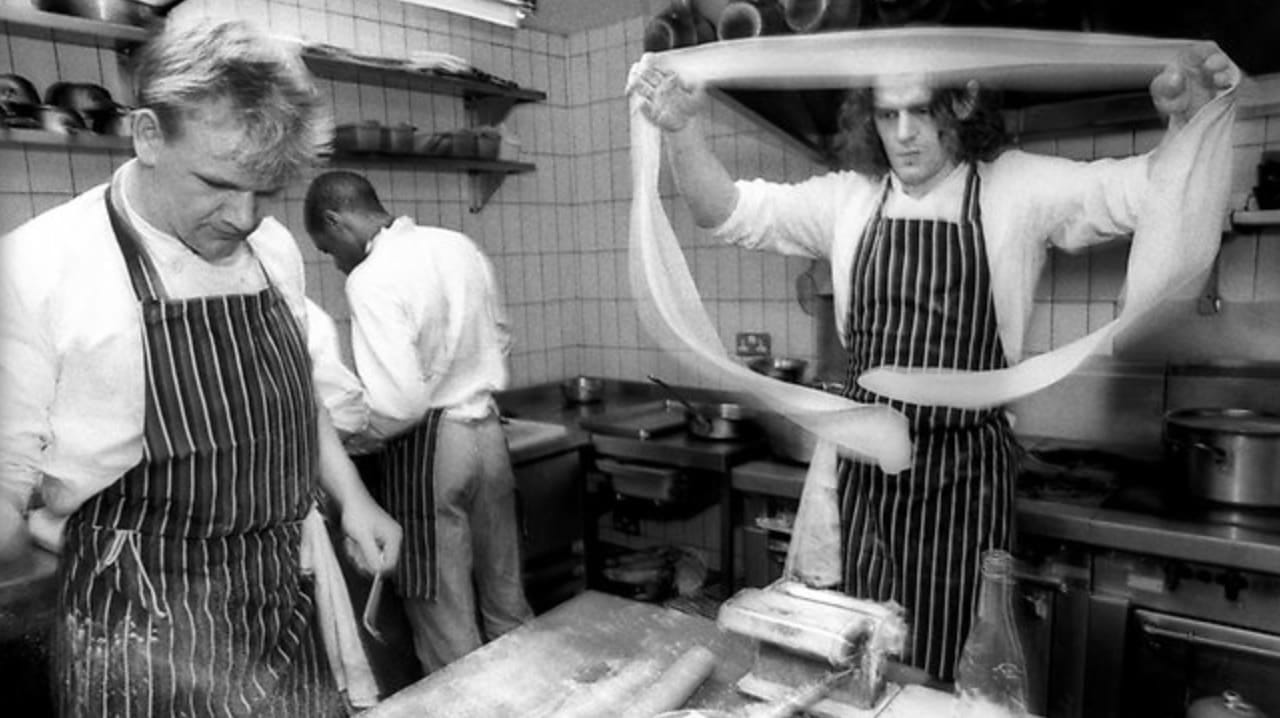
Marco Pierre White has a photograph of Lev’s ex-wife on his Instagram. They are standing on a balcony in Spain, arms flung around each other, laughing, one inch of Lev’s overlong brown fingernail blurring the borders of the image. Sometimes he imagines Marco fucking his wife in the chef’s house along the bank of the River Aire, before the blockades, making her eggs and bacon, dropping the viscera of Irish oysters into her mouth like communion, one hand on the back of her soft head, the other holding a copper pan. Lev imagines him in a white double-breasted jacket, sleeves rolled, leaning over the Aga with the heat behind him and her in a silk robe, barefoot, pretending not to notice the helicopters. In the photo, she wears a linen shirt Lev once folded into her drawer in a flat in Kraków. Her bra strap was showing. Lev had cropped that photo once, years ago, to post on his own story. 42 likes.
He retrieves a chopping board shaped like the Isle of Wight, or maybe Gibraltar, and begins opening a tin of canned tomatoes with the focus of a man disarming a bomb. The cauliflower glares at him like he’s in the corner of a hotel room, naked knees clutched to his chin like a child, dickless, meatless. He slices the crown first, the crunching give of cartilage; savages the florets like Oedipus’s eyes; then the bone of the stalk, thick and chalky and dry-marrowed like a ribcage cut wrong. The knife thumps against the wood limply and he looks over at Andrei; his people had been Hussars once, they had ripped open their enemies’ carcasses like ripe papayas and now he cans watercress; and then Harry, long legs spread beneath the kitchen table like broken banners, the soft white flesh of his thin ankles shining like Salome’s, my God, hadn’t the Celts strung adulterous women up by their feet and tits over the Northern lochs?
Somebody, anybody, has turned on the radio. He hears that his hometown — well, not really his hometown, he was born in Oxford for Christ’s sake, but the small beach-bound metropole on the edge of the West Bank that Lev puts down as his birthplace in his grant applications — has been reduced to rubble, another Jerusalem returned to the shape and size of swine’s pearls. This Crusade, this century, is not led by Richard Lionheart, but a fat woman with a degree in accounting from Boston. Harry is speaking:
“Well, of course, the great difference between the left and the right is the same as that between men and women, is that one has to wipe piss from their arsehole far more than the other—”
The conversation swells like seawater, ebbing in and out of coherence, phrases dropped like napalm in the center of Nelson’s dining table as the HMS Victory goes down, which it never did, not really. Lev is sweating as the hoplites would have in their limp canvas tents, shoulders moisture-leaden and weary, still smelling of a better man’s conquest. Bassett is replying now:
“I think the real question is, I mean, who gets to define starvation, women never vote for war, what’s that marvellous Clinton quote—”
“Binky’s brother joined the resistance in Milan, terribly silly, he lost his art history scholarship to Cambridge over it—”
“Lev, you know about this sort of stuff, when was the Last Supper painted—”
Fourteen eighty eight, he thinks bitterly to himself, Milanese tempura, indigo dried and fermented, C₁₆H₁₀N₂O₂, azure wet and hollow slapped along the halls of the Santa Maria delle Grazie. They spat in their paints, back then, filthy cavity-gummed sputum mixed with the cardamom egg yolks, they made things out of war and art and food before, no gunpowder, no saltpeter, just the detritus of wet animals trying to make and mark a bloodless history—
“Are you sure that’s enough spice? Back home we always make it with—”
“What home, cunt?”
“I’ll eat your liver like Achilles ate Hector’s—”
The bechamel bubbles, swamplike, steam mingling with cigarette smoke above the Aga. A single bite of cinnamon rises from the froth. This will be good, Lev thinks to himself, this will be God or this will be food. I will feed my countrymen in a double-breasted jacket and little epaulets made of ultramarine. My wife will be war-bride, Patroculus sick and pale, and I shall make her plump and tanned with other men’s children and shellfish from the Adriatic oilspills, fatty flesh picked at by butter-winged herons.
He imagines Marco Pierre White whispering, What kind of man doesn’t eat meat?